
Is your ability to process large amounts of information falling behind these days? Are your reaction times slowing down? If you think that this is just part of aging, you’re wrong. According to newly published research, it’s possible that you’re just not getting enough resistance exercise.
The solution? Making weightlifting a part of your health routine. Based on the findings of a recent study, even a single session is enough to make your brain sharper than before.
Resistance Exercise Spurs You to Think Faster Immediately
A study published in Psychophysiology investigated how a single session of moderate-intensity resistance exercise affects your ability to think quickly and stay mentally sharp. Participants were 121 healthy adults between 18 and 50 years old who had no neurological disorders or major health concerns that would interfere with exercise or cognition.1
After a supervised workout that used common resistance exercises at moderate intensity, the participants completed two computerized tests — one that measured inhibitory control and another that tested working memory. The researchers tested how one workout could already shift both behavior and brain signaling in ways that strengthen executive function, which includes skills like staying focused, resisting distractions, and switching between tasks.
• The findings were immediate — Reaction times improved after the resistance session, while accuracy stayed the same. In other words, the participants’ brains thought faster without making more mistakes. This shows that even a single session is enough to sharpen your thinking for tasks you do the same day.
If you face busy work schedules, intense study sessions, or complex projects, starting your workout session earlier in the day to aid in mental performance afterward can be a viable strategy.
• A detailed look at the data — The researchers reported that reaction time on the inhibitory control test improved with an effect size (the magnitude of the difference between groups2) of 0.37, which they described as a moderate improvement in processing speed. That means the workout didn’t only make people feel more alert — they responded faster when the task required them to ignore irrelevant information or manage competing cues.
The working-memory task showed an even larger improvement in reaction time, with an effect size of 0.46, reinforcing the idea that resistance exercise supports quicker mental operations across different executive skills.
• The study explored changes in brain activity, focusing on a signal called the P3 component — This is an electrical marker your brain produces when it evaluates and updates information. The authors noted that after resistance exercise, P3 latency significantly decreased during the inhibitory-control task.
A shorter P3 latency means the brain completed its information-processing step quicker. Since this shift appeared only after exercise and not after rest, it highlights a clear connection between the workout and faster neural timing.
• How the body’s physical responses influenced mental changes — The researchers measured systolic blood pressure and blood lactate, which are two biomarkers that naturally rise during resistance exercise. Their analysis showed that systolic blood pressure partially mediated the relationship between the workout and faster reaction times.
In other words, the temporary rise in blood pressure helped explain why people processed information faster. But this isn’t a sign that high blood pressure is good — it means the normal, short-term increase during exercise help push more oxygen-rich blood to the brain, enabling quicker thinking when the task demands it.
• Comparisons between the different physiological measures also revealed interesting findings — While both lactate and systolic blood pressure increased after exercise, only systolic blood pressure explained part of the cognitive improvement.
Lactate rose sharply — as expected after resistance training — but did not mediate any cognitive benefits. However, the researchers noted that it serves another purpose, which is fuel. In fact, they noted that it supports “up to 75% of the brain’s oxidative metabolism, and acting as an additional fuel source.”
• Improvements appeared across all healthy participants tested — However, the authors did emphasize that faster processing happened without any drop in accuracy, which matters because many activities in daily life require both speed and precision.
Even the Youth Gain Cognitive Benefits from Resistance Exercise
According to a meta-analysis published in Sports Medicine, resistance training positively affects thought processes and school performance in children and teenagers. The researchers pooled together 53 intervention studies and an additional 43 association studies, giving the authors a broad view of how strengthening the body influences the developing brain.3
Participants were school-aged youth between 5 and 18 years old from diverse backgrounds, school systems, and fitness levels. The exercise programs evaluated in the meta-analysis ranged from basic bodyweight routines to structured weightlifting sessions performed two to three times per week.
• The children gained cognitive benefits from weightlifting — Across the reviewed studies, resistance training consistently supports improvements in thinking skills, on-task classroom behavior, and general academic outcomes. The authors described the overall effect as “a small, positive effect on the combined outcomes of cognition, academic achievement, and on-task behaviour in school-aged youth.”
• The rate of improvement across academic-related outcomes showed up clearly in focused-strength programs — When resistance training was the primary intervention, the effect size increased to 0.26, meaning these programs promoted sharper thinking and better academic behaviors more than mixed exercise programs.
• The review also distinguished what improved most — The clearest gains surfaced in “on-task behavior” category, which reflects how well students stay engaged during lessons rather than drifting off or being distracted.
Even small boosts in on-task behavior translate into more learning absorbed per class period, smoother classroom flow, and less frustration for both students and teachers.
• Benefits are apparent right away — Many of the reviewed studies lasted only a few weeks, yet the authors already found measurable improvements in cognitive and academic outcomes. This means that short programs can already drastically benefit students within school timeframes, provided that educators can reasonably implement them.
• Some groups of participants appeared to gain more than others — Programs that targeted children with lower baseline muscular fitness produced more pronounced improvements in cognitive outcomes. As such, improving muscular strength for kids with school problems allows them to break through both physical and cognitive barriers at the same time.
• Strength training alone is more than enough to create cognitive benefits — The review also compared variables across studies to determine which exercise components mattered most. The authors found that resistance training alone produced clearer benefits than concurrent training, where strength and aerobic exercise were combined.
• The hypothesis stands up even when the research parameters were widened — The researchers also included 43 association studies, which showed that young people with higher muscular fitness scores have better cognitive performance and higher academic achievement overall.
While these studies cannot confirm cause and effect, the pattern was strong enough to support a clear link between stronger bodies and sharper minds.
• The theory behind the benefits — The review did not include an analysis of biological mechanisms, but the researchers did outline a hypothesis. Based on the reviewed literature, resistance training facilitates neurogenesis, resulting in improved executive function.4
Strength Training Tips for Beginners
It’s tempting to go all-out so you can gain the cognitive benefits of resistance training right away. However, this is a mistake that many beginners make, as more isn’t always better, especially when it comes to exercising. In fact, overdoing it actually shortens your lifespan.
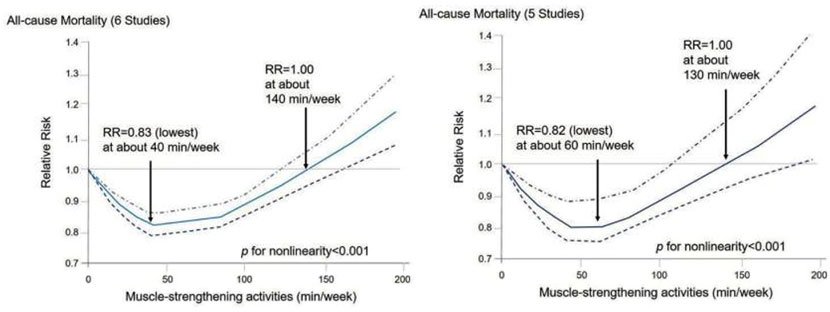
• Optimal longevity returns top out at about 40 to 60 minutes of lifting per week — In my interview with Dr. James O’Keefe, a cardiologist with the Mid-America Heart Institute at St. Luke’s Hospital in Kansas City, he showed me his research5 that pushing yourself too hard in the gym can actually work against you, especially when high-intensity training becomes excessive.
O’Keefe’s data reveals a J-shaped relationship between weekly strength training and overall mortality — benefits rise up to roughly 40 to 60 minutes per week, then level off, and eventually start to decline.
• Why excess training shortens your lifespan — Long sessions of strenuous weightlifting put the body under continuous strain. Over time, this contributes to problems like heart stress, overuse injuries, and a greater likelihood of joint or muscle damage. Overtraining also hampers your ability to recover, leading to persistent fatigue, lower performance, and a weakened immune system.
• More than two hours a week cancels out the gains — Strength training for a total of 130 to 140 minutes of each week erases the longevity edge that exercise is supposed to offer. In other words, if you spend three to four hours lifting weekly, your long-term survival outcomes look no better compared to people who do not lift at all.
• Too much lifting may be worse than doing nothing — While vigorous activity is generally healthier than total inactivity, excessive strength training is an exception. For reasons still not fully understood, going overboard with heavy, high-intensity workouts can leave you in a worse position than staying sedentary.
• Stick to 20 minutes twice weekly and don’t overfocus on lifting — The training takeaway here is simple. Keep strength sessions short and spaced out. Aim for about 20 minutes two times per week on nonconsecutive days, or a single 40-minute session. Think of strength work as a supplement to your routine, not its foundation. Moderate activities like walking deliver far broader longevity benefits.
• Even brief weekly sessions support healthy aging — If you’re having a hard time finding a consistent schedule, even lifting weights weekly is enough to boost your health. This modest level of training is consistent with research6 from Brigham Young University, showing that small weekly doses — as little as 10 to 50 minutes — can positively influence telomere length. In other words, just a little, regular strength work can help slow biological aging without exposing you to the risks of overtraining.
To learn more about the benefits of weight training for older adults and how to incorporate it into your workout routine, read “Strength Training Turns Back the Clock on Your Biological Age.”
Experiment by Incorporating Blood Flow Restriction Training
Resistance exercise already does a great deal for your overall health, and you can amplify its effects further with one simple tweak — wrapping bands around your limbs as you work out. This approach, called blood flow restriction (BFR) training — or KAATSU in Japan — involves partially limiting circulation to the arms or legs during exercise.
• How KAATSU works — Cyclical restriction of blood flow during resistance exercise stimulates the release of anti-inflammatory myokines that promote muscle growth. This is especially valuable for older adults who want to maintain strength without lifting heavy weights. Steven Munatones, a leading figure in the KAATSU community, describes the mechanism this way:
“KAATSU cycle is basically a very clever biohack that will allow the muscles to work and allow the vascular tissue to become more elastic. You don’t perceive the pain of heavy lifting, but your vascular tissue and muscle fibers are being worked out just as effectively, and you can do it for a longer period of time.”
• Your bone mineral density also improves — Research published in Frontiers in Physiology7 found that participants who practiced BFR training three times per week over six weeks experienced improvements in bone formation markers, even while using low-intensity movements. “BFR resistance training was effective for stimulating acute bone formation marker and hormone responses,” they emphasized.
Another study8 mirrored these findings, which involved a group of inactive adolescent girls. Results showed that low-intensity BFR produced benefits comparable to high-intensity routines. Notably, it reduced levels of C-terminal telopeptide (CTX), a biomarker linked with bone breakdown.
• KAATSU can also fit into your daily routine — If you’re struggling to set time aside for regular workouts, you can use KAATSU wherever you go. Munatones notes that you can wear the bands while doing simple, daily activities:
“Putting the KAATSU bands on your legs and walking down to the beach, walking your dog or just walking around the neighborhood, standing, cleaning your windows of your house, folding your clothes, banging out emails, all of these things can be done with the KAATSU bands on your arms or legs. You’re getting the benefit of exercise.”
To learn more, check out my previous article, “How to Stay Fit for Life,” in which I review the science behind KAATSU and explain in greater detail how to use it.
The main difference between KAATSU and BFR is the tool you’re using. BFR can be done with restriction bands, but KAATSU uses a device that also provides intermittent and not just constant pressure. The KAATSU set is ideal as it is far easier to dial in to the correct pressures. You also get the benefit of intermittent pressure automatically, without having to adjust the bands yourself.
I recommend the C4 model, because the C-series doesn’t have Bluetooth (which emits harmful electromagnetic fields). For a limited time, you can get 10% off any KAATSU equipment by using the promo code DRM.

Frequently Asked Questions (FAQs) About the Impact of Weightlifting on Executive Function
Q: Can a single session of resistance exercise improve cognitive performance?
A: Yes. Research shows that even a single, moderate-intensity lifting session immediately improves reaction time and mental processing speed without reducing accuracy. These benefits appear in tasks involving inhibitory control, working memory, and executive function.
Q: How does resistance exercise create these fast cognitive benefits?
A: Improvements stem from temporary rises in systolic blood pressure, enhanced blood flow to the brain, faster neural processing (reduced P3 latency), and more efficient communication between attention-control brain networks.
Q: Do children and teenagers also gain cognitive benefits from resistance training?
A: Yes. Research shows small but consistent improvements in youth cognition, classroom behavior, and academic performance — especially for children with lower baseline muscular fitness.
Q: How much strength training is optimal for longevity and health?
A: Research suggests 40 to 60 minutes per week offers the best longevity benefits. Excessive lifting (over 2 hours weekly) cancels health gains, increases strain, and elevates risks associated with overtraining.
Q: What is blood flow restriction (KAATSU) training, and why use it?
A: BFR/KAATSU involves lightly restricting limb blood flow during exercise to stimulate muscle growth, bone health, and strength at low intensity. It’s especially useful for older adults and can be integrated into everyday activities.
Test Your Knowledge with Today’s Quiz!
Take today’s quiz to see how much you’ve learned from yesterday’s Mercola.com article.
What type of cell relies on butyrate for most of its energy?