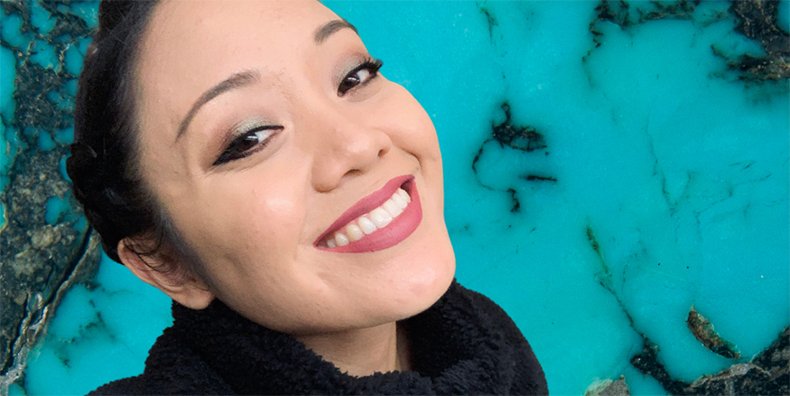

The artist known as AUDFACED shares how a bipolar disorder diagnosis helped her trade hypomania for true stability.
Editor’s Note: We first shared Cat’s story in 2022. While life has moved forward for Cat since then, her journey offers timeless lessons in resilience and self-discovery that remain just as powerful for our community today. Medical details have been reviewed and updated for current accuracy.
Los Angeles makeup artist Cat Tanchanco has a motto: “Under every mask is a story.”
“Ultimately, it’s about being curious about the story that every person has, and having empathy,” she says. “There’s so much we don’t know about people just by looking at them.”
At the time of the original reporting, Tanchanco was 30 and had built a career on creating masks of one sort or another. She crafted makeup looks and special effects for the Batman Beyond TV series, the Crypt TV digital content company, and a variety of other film and video projects.
She’s also a mixed-media creative artist in her own right, with a degree in film and video from California Institute of the Arts.
Known professionally as AUDFACED (inspired by the word “odd”), Tanchanco started posting makeup tutorials on YouTube during her first year of college. Getting hooked on Tim Burton movies back in eighth grade led to her fascination with ghastly-looking characters.
“A lot of people in my life saw me as quiet and timid and kind of one-dimensional, and I remember being drawn to the macabre because it felt like I could explore more there,” Tanchanco reflected. “Getting to become different characters and expressing parts of myself other than what people expected of me is what drew me in.”
The quiet Filipino-American girl evolved into a woman who describes her personality as “weird, spunky, outcast.” For more than a decade, those qualities helped mask her underlying bipolar 2 disorder. Getting the diagnosis in 2020 left her wondering how much of her personality was truly her.
Managing Hidden Hypomania
Tanchanco said she spent her twenties “swinging too hard” between mood episodes. With the wisdom of hindsight, she saw how hypomania made her extra talkative, hyper-creative, and so energetic she booked a relentless stream of gigs. When she couldn’t sleep, she found herself flooded with ideas for new makeup or media projects, or collaborations with other creatives.
Ultimately, the stress of her overbooked schedule would trigger a depressive episode. She would lose her motivation to meet deadlines, disappear from her social media accounts for weeks or months. She would second-guess herself, wondering whether she’d ever be able to feel imaginative again.
The film industry’s unpredictable nature didn’t help. Tanchanco noted that the field is volatile and unstable, with many changing personalities.
For example, call sheets — the daily schedules that specify when actors have to be on set, in makeup, and ready for filming, among other things — can be handed out at 3 a.m. That only exacerbated an already unregulated sleep schedule. At one point, the lack of shut-eye made her so irritable she snapped at an assistant director.
Tanchanco was 22 when that happened, well before she was aware of her bipolar diagnosis. Following a couple of years of therapy and research, she developed a metaphorical work shed of tools she uses to stay balanced, keep on task, and handle stressful situations.
When things get tense on set, Tanchanco would choose to walk away. She focused on her breathing to calm down. She also packed protein shakes and other simple snacks to keep her blood sugar stable.
Self-Understanding and Disclosure
After receiving her diagnosis, Tanchanco decided to take a break from the industry to ensure she truly understood herself and could find more sustainable ways to pursue what she loved.
By the time of reporting, she had been easing back into film and TV gigs, including the 2022 Sundance Film Festival documentary Brainwashed: Sex-Camera-Power. She also continued to work on her own photography, video, and performance art endeavors.
She took a position as community manager at Art With Impact, a nonprofit that promotes mental wellness by creating space for young people to connect through art, film, and media. As part of her responsibilities, Tanchanco managed a monthly mental health short film competition and coordinated special events. It was a job custom-made for her values: marrying art with meaningful conversations about mental health to foster healing.
A conversation about bipolar disorder during a panel she was participating in spurred her to reveal her diagnosis to coworkers. She was scared while doing it, she revealed, but her colleagues were supportive. She’s since become increasingly comfortable talking about her diagnosis in other contexts — lowering her mask, so to speak.
Bipolar, Creativity, and Self-Acceptance
She also learned that reining in her bipolar extremes would not result in losing friends or a job — something she originally feared.
“I was afraid becoming stable would mean losing my creativity and losing the spark of my personality that I thought people loved about me,” she said. “I thought I would lose everything that I believed made me interesting, unique, and also productive.”
At first, she struggled to move past what she called her “denial, ‘my life is fine as it is’ stage.” One of her first major steps was buying The Bipolar Disorder Workbook: Powerful Tools and Practical Resources for Bipolar 2 and Cyclothymia, by Peter Forster, MD, and Gina Gregory, LCSW.
“I remember the day I bought it,” she recalled. “I was trying to hide the book title from the cashier who rang me up.”
That workbook helped move her toward acceptance. She noted that she no longer saw herself as “something to fix.” ”
Tanchanco makes taking care of herself her first priority, following a regimented plan that includes keeping a journal she sifts through for patterns in her mood shifts.
“It’s not, ‘If I have time.’ It’s pure maintenance,” she said. “That’s how I’m going to best enjoy this life. It’s worth it.”
Cat Tanchanco’s Wellness Tips
1. Self-Education
Tanchanco hunts down articles about living with bipolar, reads them more than once, then makes checklists from the advice she finds most helpful. For example, she sets a timer for 30 minutes to one hour when she’s working to focus more easily on a single task without getting distracted.
2. Selectivity
Tanchanco said she previously struggled with “bright shiny object syndrome” — starting many projects simultaneously but finishing only a few. Now she looks over a list of potential projects to identify those that will sustain her interest without making her feel overloaded, then chooses one at a time to tackle.
3. Two-Day Decision-Making Delay
She builds in a 48-hour grace period before making decisions, such as spending money, reaching out to people, or starting an art project. If an item catches her eye while online shopping, she bookmarks it for two days. If she still wants the item after that time and it fits her budget, she gives herself permission to buy it.
You can find more of Tanchanco’s advocacy on Instagram at bipolar.care.tips.
UPDATED: Printed as “Barefaced,” Summer 2022