

By Michelle Guevara-Nieto, PhD, postdoctoral fellow at the Genomic Epidemiology Branch at the International Agency for Research on Cancer (IARC) and member of the AACR Associate Member Council
When the American Association for Cancer Research (AACR) launched the AACR on Campus initiative, its mission was clear: to bring cutting-edge science, mentorship, and professional development directly to regions where strengthening research capacity can have lasting impact. Bringing AACR on Campus to Colombia was more than an academic milestone, it was an opportunity to connect local excellence with the global cancer research community.
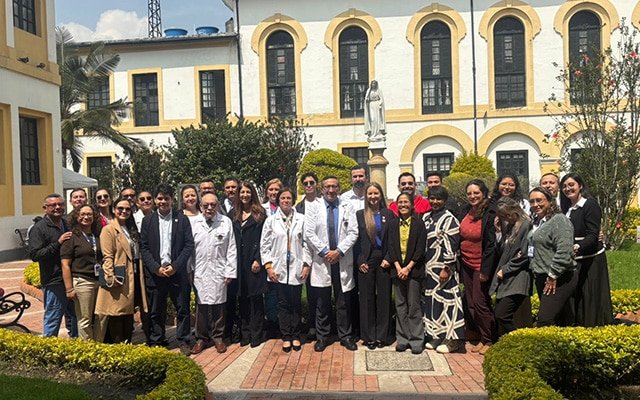
In partnership with the Instituto Nacional de Cancerología and Fundación Valle del Lili, and with support from AstraZeneca, AACR held events in Bogotá and Cali this past February, bringing together local and international experts to engage with trainees, clinicians, and researchers across the region.
For me, hosting this program in Bogotá was also deeply personal. As a Colombian scientist and 2022 AACR Global Scholar-in-Training Award (GSITA) recipient, I have experienced firsthand how access to international networks can be transformative. Engaging with AACR early in my career expanded my scientific perspective and opened doors that shaped my trajectory. Bringing this initiative to Colombia felt like creating that same opportunity for others, ensuring that trainees, clinicians, and investigators in our region can see themselves as part of a global scientific dialogue.
From Digital Innovation to Real-world Impact
The scientific program was intentionally centered on digital pathology and implementation science, two areas that together reflect both the future of cancer research and the realities of health care systems in Colombia.
From a clinical and operational perspective, local expert Andrés Mosquera-Zamudio, MD, of Fundación Universitaria de Ciencias de la Salud, highlighted how artificial intelligence (AI) and telepathology are transitioning from pilot projects to standard tools in routine diagnostic practice. These technologies enable more objective, reproducible, and quantitative assessments, reducing interobserver variability and improving efficiency through automation of tasks such as screening and triage. Importantly, this transformation does not replace the pathologist but redefines their role toward more supervisory and integrative functions while helping to improve their speed, accuracy, and reach. He also emphasized that successful adoption depends on robust validation, transparency, governance, and ethical frameworks.
Adding a research and systems perspective, Rafael Parra-Medina, MD, PhD, of Instituto Nacional de Cancerología, discussed how embedding AI within digital pathology environments can enhance the consistency and reproducibility of diagnostic and biomarker evaluation. Centralized, database-driven platforms can support tissue-based research, education, and drug development through computational pathology, he explained. However, he also highlighted structural challenges in Latin America, including fragmented pathology services and the lack of reimbursement models, which currently limit the scalability of these innovations.
Providing a global perspective, Giovanni Lujan, MD, of The Ohio State University, emphasized that digital pathology represents a fundamental transformation in how the field operates, from glass to pixels, from isolated silos to integrated ecosystems, and from subjective interpretation to computationally supported intelligence. This shift also opens the possibility of expanding diagnostic access globally.
Expanding on the translational dimension, Hadassah Sade, PhD, of AstraZeneca, highlighted how computational pathology is advancing precision oncology. By enabling quantitative, single-cell-level biomarker assessment and identifying predictive molecular signatures, these approaches improve patient selection and outcome prediction, particularly for targeted therapies such as antibody-drug conjugates.
Bridging innovation with real-world application, Marcela Gómez-Suárez, MD, PhD, of Fundación Universitaria de Ciencias de la Salud, shared lessons from the GLORIA National Telepathology Network, the largest such network in Colombia. She emphasized that successful implementation depends on adapting strategies to real contexts, including engaging pathologists as implementers, simplifying consent processes, building regional networks, and prioritizing trust through community engagement. As she noted, digital pathology moves images, but implementation science, supported by public engagement, is what ultimately moves trust.
Implementation Science: Turning Evidence Into Impact
If digital pathology represents technological progress, implementation science ensures that progress reaches patients.
Providing a foundation, Jesse Nodora, DrPH, MPH, of the University of California, San Diego, outlined the key elements required to translate evidence into practice, including clearly defined interventions, implementation strategies, theoretical frameworks, measurable outcomes, and stakeholder engagement.
Complementing this, Raúl Murillo, MD, PhD, MPH, of Pontificia Universidad Javeriana in Colombia, offered guiding principles for implementation research in low- and middle-income countries. He emphasized that research is most valuable when it serves implementation and contributes directly to practice. Flexibility in methods, a strong focus on context, and the recognition of implementers as the true drivers of change are essential. He also highlighted the importance of integrating research into policy and routine practice to ensure sustainability.

Building on these perspectives, María E. Fernández, PhD, of UTHealth Houston, emphasized that implementation science provides systematic approaches to integrate theory, data, and community engagement in order to accelerate the adoption of evidence-based interventions. She highlighted that meaningful progress requires collaboration with communities and health care systems to address barriers to health equity.
Together, these perspectives reinforced a central message: Advancing cancer research requires not only innovation, but also adaptive, context-aware implementation strategies that ensure equitable access and sustainable impact.
Professional Development: Building the Next Generation
The second day of the program focused on professional development, equipping participants with practical tools to navigate research careers. I had the privilege of chairing the panel discussion on “Funding Opportunities and Global Collaborations,” an experience that was both professionally meaningful and personally reflective.
Sharing the stage with Christina (Leah) Kline, PhD, from AACR’s Research and Grants Administration department, along with Fernandez and Sade, reinforced a central idea: while science is driven by data, it is sustained by people, persistence, and powerful storytelling.
Our discussion moved beyond traditional advice to focus on real-world challenges. Successful grant applications are not only technically sound but also tell a compelling story that connects scientific innovation to meaningful impact. Resilience also emerged as a key theme. For many researchers, particularly in low- and middle-income settings, administrative and structural barriers are common, but persistence in navigating these challenges is essential.

The conversation also highlighted the role of industry as a catalyst for innovation. Collaborative opportunities with partners such as AstraZeneca can help bridge local research with global development pipelines, enhancing both scientific and translational potential.
The session on scholarly publishing led by Rachel Hodge, PhD, of the AACR journal Clinical Cancer Research, provided insight into the editorial and peer-review process, while a panel discussion on ethics and research integrity in the era of AI underscored the importance of transparency, bias mitigation, and responsible data use.
Poster Sessions: Recognizing Emerging Leaders
The poster sessions in both cities captured the energy and potential of Colombia’s next generation of cancer researchers.
In Bogotá, three investigators from the Instituto Nacional de Cancerología were recognized:
- Gimar Helena Facundo Navia, MD, provided critical epidemiological insights into gallbladder cancer, a malignancy that remains understudied despite its regional significance.
- Guillermo Andrés Cárdenas Montoya, MSc, presented preliminary findings on high-risk HPV prevalence in Colombian women from diverse ancestral backgrounds, highlighting the importance of considering genetic ancestry and sociodemographic vulnerability in understanding disparities in cervical cancer risk and progression.
- Carlos Alberto Orozco Castaño, PhD, demonstrated the power of bioinformatics, using multiomics analysis and public genomic data to investigate the role of Galectin-1 across different cancer types.
In Cali, the recognition went to Leidy Tatiana Ordoñez Mora, PhD, of Universidad Santiago de Cali, whose work highlighted the importance of patient-centered care. Her randomized controlled trial explored how neuroscience education can empower patients to manage and reduce the interference of cancer-related pain in their daily lives.
As the Best Poster Prize winners at the AACR on Campus Colombia events, supported by AstraZeneca, each one will receive a $2,500 travel award to attend the AACR Annual Meeting 2027, where they will have the opportunity to present their findings on a global stage and further expand their scientific networks.

AACR on Campus Colombia: A Lasting Impact
The impact of AACR on Campus Colombia extends far beyond the sessions themselves. It created a space where ideas evolved into collaborations and where early-career investigators began to see new possibilities for their work. In many ways, the poster awardees embody this future. Their research spans epidemiology, computational biology, molecular oncology, and patient-centered care, fields that reflect both local priorities and global relevance. More importantly, their experience signals a shift in perspective: from working locally to thinking globally, from contributing individually to belonging collectively.
As one participant shared, “This meeting made me feel part of a global scientific community.” Poster winner Orozco Castaño said that the experience “shifted the way I see my work, now I think about how it fits into an international conversation.” Another noted that the event strengthened their motivation to pursue AACR membership and future collaborations. These moments, where emerging investigators see themselves as part of a broader scientific community, may be among the most lasting impacts of these events.