

,
by Anthony Letai, M.D., Ph.D.
Having just attended the American Society of Clinical Oncology (ASCO) Annual Meeting, I can say: we are living through a remarkable moment in cancer research.
The ASCO Annual Meeting brings together the community closest to the patients we serve—oncologists, clinical investigators, nurses, patient advocates, and others whose day-to-day is focused on improving the lives of people with cancer. Their work was on full display at the Chicago meeting, May 29–June 2, showcasing how decades of foundational research are leading to new treatments and how new technologies are helping us reach further and faster toward better patient outcomes.
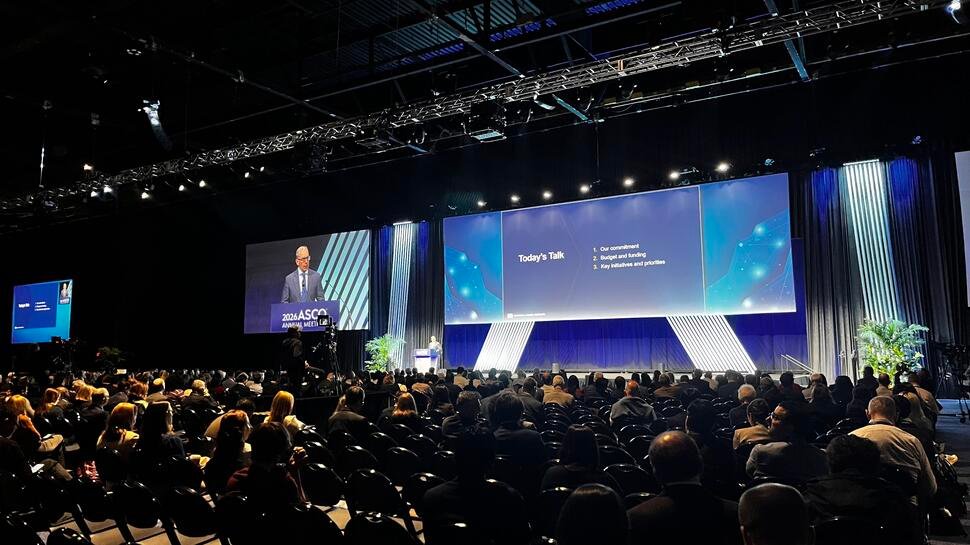
I was honored to address attendees during the opening session, providing an update on the health of the cancer research enterprise. In light of concerns about the pace of awards and the changing funding landscape, I wanted to reassure attendees that NCI staff are working as quickly as possible this summer to review and approve grants and keep funding moving.
Leaving Chicago, I found myself reflecting on three themes that emerged throughout the meeting: the accelerating pace of scientific progress, the need to improve how we conduct research, especially clinical trials, and the strength of the cancer research and care community.
The pace of progress
Among the moments I keep returning to is the 42-second standing ovation that interrupted a plenary presentation by Dr. Brian Wolpin, medical oncologist and clinical investigator in the Center for Gastrointestinal Oncology at Dana-Farber Cancer Institute. As he delivered the phase III trial results—that daraxonrasib, a RAS(on) inhibitor, nearly doubled median overall survival compared with chemotherapy for people with previously treated, advanced pancreatic cancer—the audience erupted in spontaneous applause.
For the community, this was a long-awaited win against one of the most difficult cancers to treat. Pancreatic cancer has resisted progress for decades, with researchers nearly drowning in failed attempts to rein in the disease. The outpouring of joy at Dr. Wolpin’s presentation was everyone finally coming up for air. While there is still much to learn about the drug and its side effects, the community has reason for optimism.
It’s important to remember that a breakthrough like this is built on decades of foundational science, much of it supported by NCI and NIH grants. Years of research have taught us that more than 90% of pancreatic cancers—and about 30% of all human cancers—are driven by changes in RAS genes. For 40 years, RAS has been considered one of cancer biology’s most important—and most frustrating—targets.
After years of dead ends and failed attempts to drug RAS, a turning point came in 2013. That year, NCI-supported scientists Dr. Kevan Shokat and colleagues at the University of California San Francisco (UCSF) discovered a previously hidden pocket on the KRAS G12C mutant form of KRAS, a protein made by the RAS gene family. In its active “on” state, this mutant protein causes uncontrolled cell growth and cancer. Dr. Shokat’s team developed small molecules that bind to the newly discovered pocket in the “off” state, effectively inactivating the protein. Their work showed that RAS—previously considered “undruggable”—could, in fact, be targeted, opening a new path for drug development.
Around the same time, NCI launched the RAS Initiative, under the leadership of Dr. Frank McCormick, also at UCSF, to accelerate research on this important cancer target. The initiative built a global center of RAS research and technology that helped define the structure of RAS proteins, measure RAS activation, pioneer advanced imaging tools, and create additional small molecule RAS inhibitors.
Together, these developments energized the field and inspired researchers across academia, NCI-Designated Cancer Centers, and pharmaceutical and biotechnology companies like Revolution Medicines, creator of daraxonrasib, to pursue new approaches to RAS-driven cancers.
Daraxonrasib is a powerful example of why sustained public investment in science matters. Time, resources, and support for researchers paid for by the government to tackle difficult cancer problems has led time and again to transformational progress.
Indeed, we are seeing broad returns on decades of investment across the cancer research field. Advances in AI and machine learning, genomics, and data-driven insights are fueling an accelerated pace of discovery across the cancer research continuum.
Speeding the path from idea to patient
At the same time, the speed of discovery has often outpaced the speed at which advances reach patients. A key focus of ASCO discussions was how to move more quickly from promising laboratory findings to real benefits for patients.
During the meeting, I participated in two sessions focused on accelerating clinical trial activation in the United States. One was a closed meeting of stakeholders from organizations including ASCO, the American Association of Clinical Investigators, and Friends of Cancer Research. The other was a public panel discussion hosted by the U.S. Food and Drug Administration (FDA).
All of us agreed that many delays stem from operational inefficiencies that have accumulated over time. Simplifying trial designs, reducing unnecessary complexity, and standardizing contracts and other processes could help accelerate trial activation. The challenge is determining which steps are necessary and which can be simplified or removed while preserving patient safety and scientific rigor.
We are currently convening stakeholders across HHS, FDA, cancer centers, and industry to implement what we learn from successful models both here and abroad. In Australia, for example, some early-phase trials can move from application to enrollment in as little as 8 weeks. We are looking closely at elements of their system that enable that speed.
Speeding up trial activation times will require collaboration among the entire research and care community. Fortunately, everyone recognizes the urgency of the issue and is eager to work together toward solutions.
Supporting the cancer research and care community
That shared commitment is a reminder that progress in cancer research depends not only on great ideas but also on the people driving innovation—on a community willing to work together to ensure new discoveries reach the patients who need them.
One of NCI’s most important roles is supporting the people who make progress possible. At ASCO, during my opening remarks, FDA panel participation, and throughout countless conversations with attendees, I emphasized that NCI is more than a funder. We are a partner to researchers, clinicians, cancer centers, patient advocates, and industry across the full arc of cancer research and care.
NCI has a responsibility to convene, coordinate, and strengthen the community, enabling cross-sector collaborations that can overcome our biggest challenges. An upcoming opportunity to collaborate with us will be during our workshop to advance functional precision medicine on July 1–2.
The progress on display at ASCO demonstrated what this community can achieve when discovery, care, and collaboration move together. NCI is committed to sustaining that momentum and ensuring it translates into better outcomes for patients.