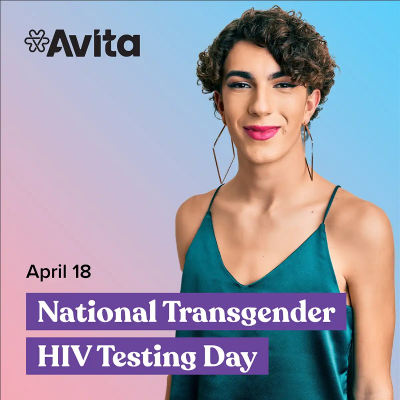

Saturday, April 18, marks National Transgender HIV Testing Day 2026 (#NTHTD and #TransHIV).Transgender, gender-nonconforming and nonbinary people are at greater risk for HIV and are more likely to be living with HIV than the population at large—and they often face more barriers to care and treatment.
As such, this national awareness day promotes the importance of routine testing among the estimated 2.8 million people ages 13 and older who identify as transgender in the United States.
“HIV testing is a powerful tool for prevention and empowerment. Knowing your status opens the door to timely care, effective prevention options and greater control over your sexual health,” writes Avita Care Solutions about National Transgender HIV Testing Day.
“This day is a call to expand access to affirming services, reduce stigma and ensure transgender and nonbinary people are fully supported across the HIV care continuum,” continues Avita Care, which specialized in LGBTQ, HIV and sexual wellness care, including pre-exposure prophylaxis (PrEP), the pills and long-acting injectables that prevent HIV-negative people from contracting the virus.
April 18 is National Transgender #HIV Testing Day #NTHTD Stigma & discrimination affect the lives of transgender & gender-expansive community members in many ways and it’s well documented that #stigma & discrimination keep people from getting tested for HIV & engaging in HIV prevention. #gettested
[image or embed]
— The Well Project (@thewellprojecthiv.bsky.social) April 17, 2026 at 8:37 PM
It’s important to know your status. If you’re newly diagnosed, you have many treatment options. People with HIV who achieve and maintain viral suppression experience slower disease progression, enjoy better overall health and are less likely to develop opportunistic illnesses. What’s more, people with an undetectable viral load don’t transmit HIV to others through sex. This is known as treatment as prevention, or Undetectable Equals Untransmittable (U=U).
Avita Care Solutions promotes National Transgender HIV Testing DayCourtesy of Avita Care Solutions
On its website, AvitaPharmacy.com, the organization also includes social media templates with hashtags and captions you can share online to promote the awareness day.
Click #NTHTD and #TransHIV on social media to find related campaigns and events. Several examples from recent years are included in this post. Other related hashtags include #TransHealth #StopHIVStigma #GetTested #KnowYourStatus #EndHIV and #HealthEquality.
NTHTD was established in 2016 by the Centers for Disease Control and Prevention (CDC) and the University of California San Francisco’s Center of Excellence for Transgender Health (CoE).
The World Health Organization estimates that transgender people are around 13 times more likely to be living with HIV than other adults. Estimates suggest that more than 20% of trans women are HIV positive in some regions, and they account for 6% of new cases in Latin America and 7% in Asia and the Pacific.
In the United States, transgender people accounted for about 2% of new HIV diagnoses in 2019, according to the CDC. Updated and reliable data is harder to come by as the CDC’s annual HIV surveillance report in 2024 did not include trans people and as of last year, the Trump administration has stopped collecting information on transgender and gender-diverse people and has largely removed relevant information from government health websites (under the guise of ending programs that support diversity, equity and inclusion, or DEI).
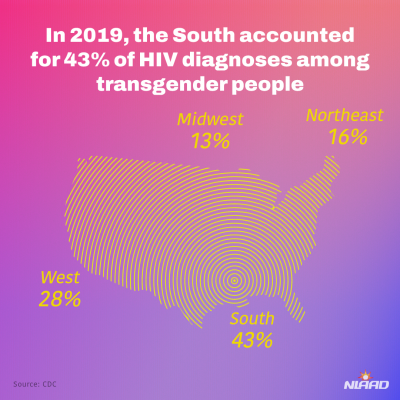
Latino Commission on AIDS shares infographics for National Transgender HIV Testing DayCourtesy of Latino Commission on AIDS
For more information on the population, see the POZ Basics on HIV and Transgender People and for a collection of POZ articles, click #Transgender.
AIDSVu.org also offers downloadable graphics along with data and important context. “Transgender people often experience structural and social barriers that impact HIV risk and access to care,” writes AIDSVu.org. “Higher rates of poverty, unemployment and housing instability increase vulnerability, and transgender people living with HIV report higher levels of stigma and higher rates of homelessness or unstable housing compared to cisgender populations. Limited access to gender-affirming and HIV-related care further contributes to gaps in prevention and treatment. At the same time, evidence shows that access to gender-affirming care is associated with improved outcomes, including increased viral suppression and reduced HIV risk.”
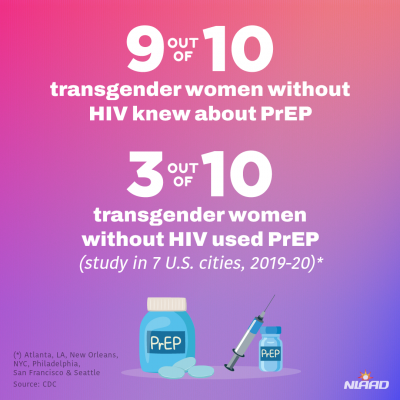
Latino Commission on AIDS shares infographics for National Transgender HIV Testing DayCourtesy of Latino Commission on AIDS
Additional data highlighted by AIDSVu include:
- From 2019 to 2024, new HIV diagnoses among transgender people in New York City increased by 21%, driven by a 30% rise among transgender women, while diagnoses among transgender men decreased by 80%.
- In 2024, Black and Latino transgender people accounted for 88% of new HIV diagnoses among transgender individuals, underscoring ongoing racial and ethnic inequities.
- in 2022, 73% of transgender women and 64% of transgender men living with HIV lived below the federal poverty level.
- Transgender individuals living with HIV also reported higher rates of homelessness or unstable housing than cis-men or cis-women living with HIV in 2021.
Tomorrow, Saturday, April 18 is National Transgender HIV Testing Day. #NTHTD Celebrate community strength, self-knowledge, and care. Know your status and access affirming prevention and services. Find testing sites near you at iamhivpossible.org
[image or embed]
— Oni Blackstock, MD MHS (@oniblackstock.bsky.social) April 17, 2026 at 9:43 AM
Click here to learn more about 2026 HIV and AIDS awareness days and for a printable poster.