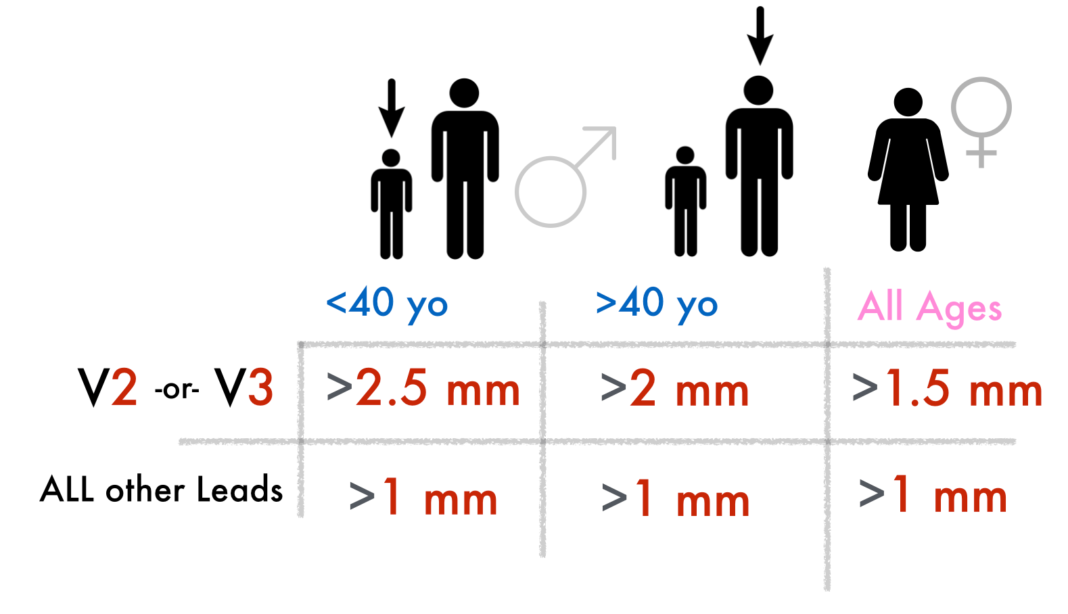


Why different cut-offs for diagnosing STEMI in men and women ?
April 6, 2026 by dr s venkatesan
In healthy people, some J-point/ST elevation in V2–V3 is normal. This physiologic elevation is greater in men than in women Using the same cutoff for everyone would cause many false-positive STEMI calls in men (over-diagnosis) while missing true ischemia in women (under-diagnosis).
Molecular and Ionic basis
The difference is not because gender based difference in ischemia response . It is because ventricular repolarization differs between men and women due to sex hormones acting on cardiac ion channels. These differences appear at puberty and are belived to be driven by androgenic hormones.
Mechanism
Transient outward potassium current (Ito, carried by K+channels) is higher in male ventricular epicardium than in females. Testosterone up-regulates Ito density and function. In the action potential (AP) of epicardial myocytes higher Ito produces a deeper phase-1 notch This creates a larger transmural voltage gradient (epicardium vs. endocardium during phases 1–2 of the AP. This transaltes in the surface ECG as J-point elevation reflecting early-repolarization voltage gradients. Greater gradient steepr the J-point and higher ST takeoff .This is called the the classic “male-pattern early reppolarization.”Women have a shallow j point.
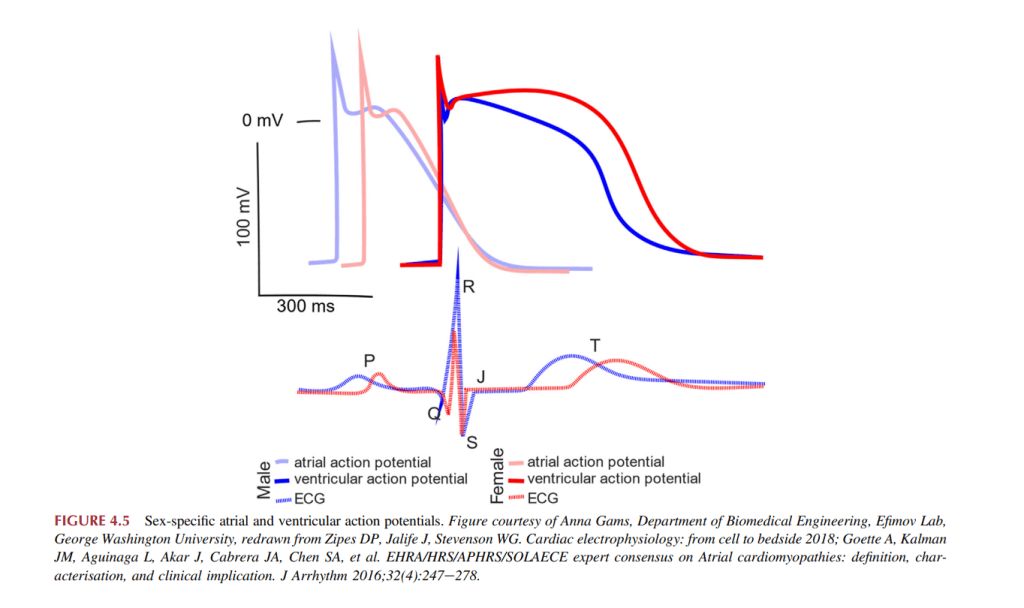
Image source : Blinova, Ksenia (2020). Sex and Cardiac Electrophysiology Atrial and ventricular tissue electrophysiology.
Why this difference is not seen in limb leads ?
Note : This J point difference is more prounuced in chest leads only because they are unipolar , and very close to epicardium and picks up the difference
Final message
Whenever we have trouble identifying the true mechanism in any gender-related difference, it is easy to blame it on either testosterone or estrogen. As in the atheletic filed , men are naturally a little faster to fly off from the start-boots in the early phase of repolarization. This also has some connection with why women have longer basal QT intervals than men. The whole repolarization process is slow but steady. We can alos realise, in spite of longer QT, women have less incidence of primary ventricular arrhythmias even during ACS, implying better reslience and stress handling. (Ref 2)
Reference
1.Blinova, Ksenia (2020). Sex and Cardiac Electrophysiology || Atrial and ventricular tissue electrophysiology. , (), 39–48. doi:10.1016/B978-0-12-817728-0.00004
2.Weizman O, Marijon E, Narayanan K, et al. Incidence, Characteristics, and Outcomes of Ventricular Fibrillation Complicating Acute Myocardial Infarction in Women Admitted Alive in the Hospital. Journal of the American Heart Association. 2022;11(17):e025959. doi:10.1161/JAHA.122.025959.