
How Important is LA pumping function in LV filling ?
April 10, 2026 by dr s venkatesan
LA has three important functions, namely reservoir, conduit, and pumping. Which among the three is the most and least important?
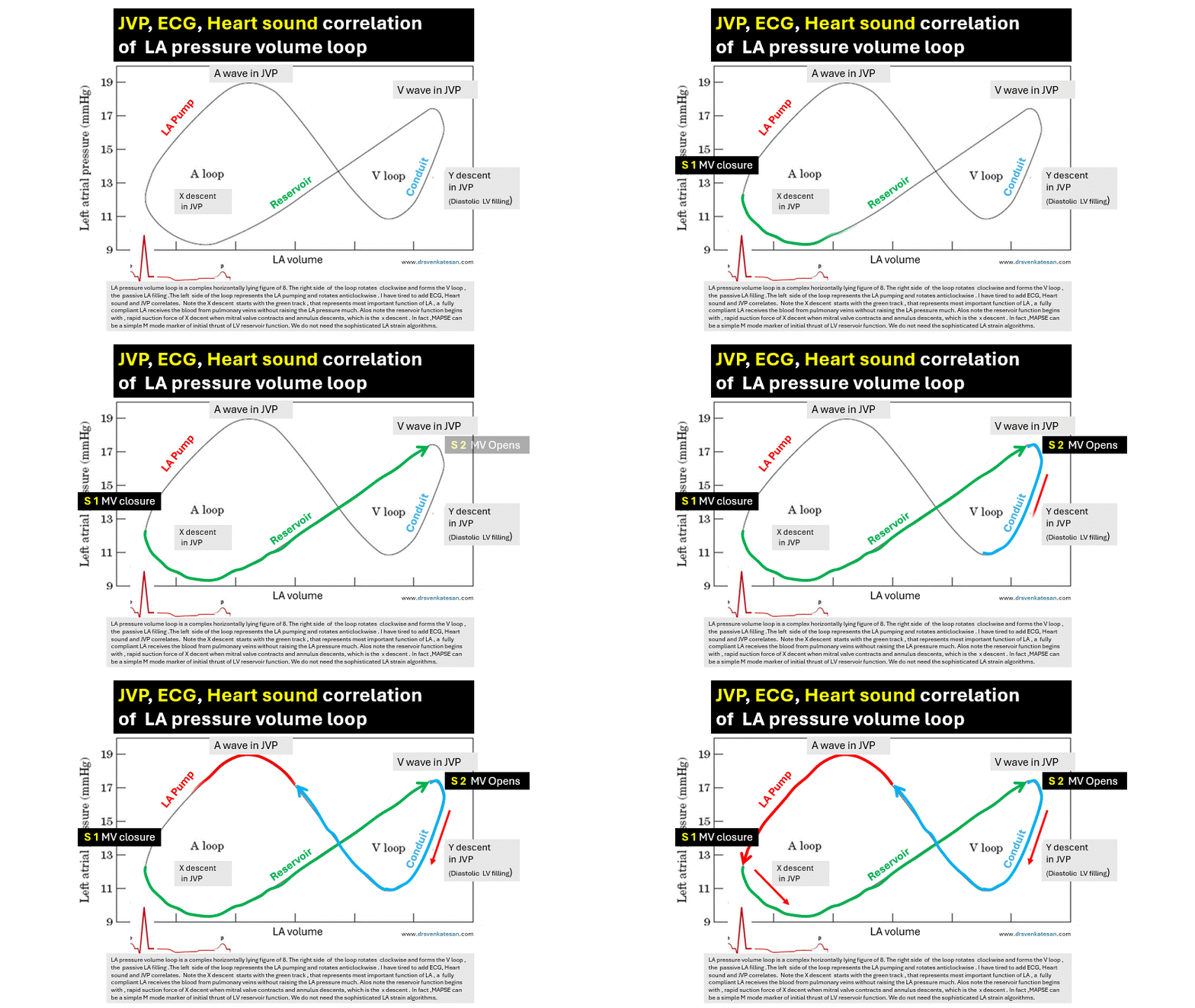
Find out the answer yourself. One clue: Atrial systole is very brief, hardly lasting for 120 ms (equal to P wave duration). The rest of the period, the atria are taking rest. You think so? No, It gets ready to receive and deliver the entire stroke volume meant for the next LV contraction. Note the green path; it is not only long, it has to be less steep. For this, we require an agile LA (technically good compliant LA). If the LA is stiff, the LA struggles to form a good V loop, and it depends more on its pumping function. That is, the A loop contribution is more than the physiological 25%. So, as of now, the most critical function of LA seems to be its reservoir function, which is often measured by LA strain; normal values are -18 (luckily the same value as LV strain, easy to remember).
By the way, coming to the least important functional component: even a 65-year-old elderly person just walks to your office with AF and a rapid rate. He just complains of some palpitations. Nothing else. His BP is normal. What does this mean? Most healthy adults do not really depend on the atrial booster pump for hemodynamic stability ?. This is a very provocative statement and needs clarification from experts. One more piece of evidence is the long debate over rate vs. rhythm control in AF. With almost equipoise between rate and rhythm control, I wonder when exactly this atrial booster pump matters? Understanding LA pressure volume loop may look complex. When we spend some time, it becomes less fritetning.Think about how, MS, acute and chronic MR or LV dysfucntion modify this loop.
Final message
William Harvey might have discovered the circulatory system, but it is Carl Wiggers, the father of cardiac physiology and hemodynamics, whose wisdom taught us that the heart plays a silent hemodynamic orchestra called systole and diastole. We, the current generation of cardiologists, are happy to stop with that. Do we need to have a separate cardiac cycle dedicated to the atria? Which would mean we need to know the nuances of the isolated atrial cardiac cycle (atrial systole and diastole) in and out of sync with the LV. Maybe someone who carries the same passion as Wiggers will soon emerge and do it.
Postamble
One point, I am yet to understand fully is, why should the LA pressure goes up during the conduit function (See the the blue line going north) as the LV fills. Maybe LA is restricted and trying to get equilibrated with the rasing slope of LVEDP, as the LV is getting filled rapidly.
Reference
1.Thomas L, Marwick TH, Popescu BA, Donal E, Badano LP. Left Atrial Structure and Function, and Left Ventricular Diastolic Dysfunction: JACC State-of-the-Art Review. J Am Coll Cardiol. 2019 Apr 23;73(15):1961-1977. doi: 10.1016/j.jacc.2019.01.059. PMID: 31000000.
Link 2