
How did we fall for the newer MCS devices in cardiogenic shock ? A call for continued, “Guilt-free” usage of IABP
May 19, 2026 by dr s venkatesan
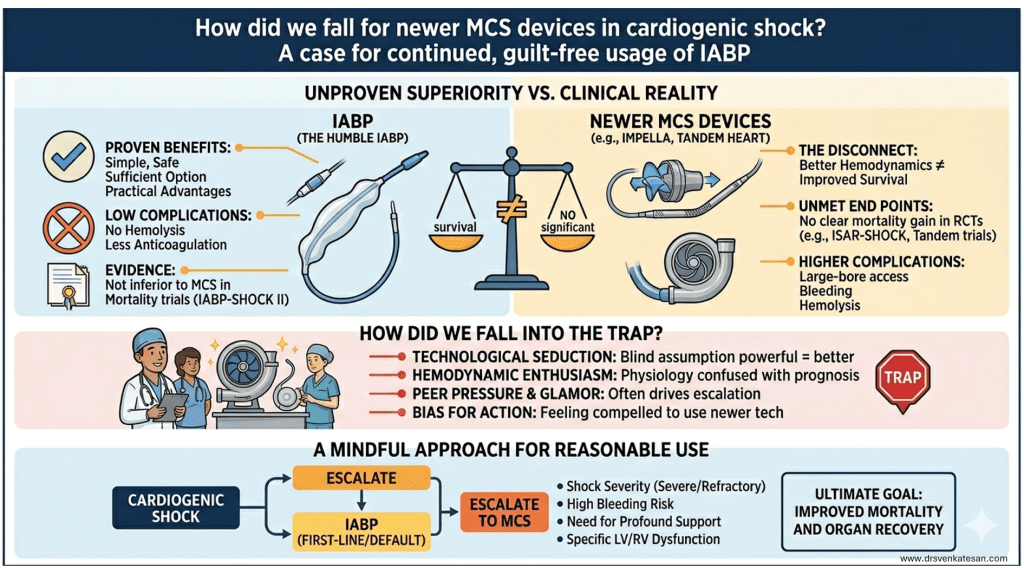
The rise of percutaneous mechanical circulatory support (MCS) in cardiogenic shock is phenomenal. Reason : It is a blind assumption that newer and powerful intra /extra cardiac devices must improve outcomes in CS. This has happened inspire of the fact no RCTs proved they are superior to the humble IABP. For most patients, IABP remains a simpler, safer, and often sufficient option, while routine escalation to Impella or Tandem Heart is driven more by hemodynamic enthusiasm than proven mortality benefit.
How did we fell into the trap?
Cardiogenic shock is a setting where technology can appear decisive even when evidence is uncertain. Devices that generate more flow and better filling pressures naturally attract attention, but physiology is not the same as prognosis. The real question is whether a device improves survival, organ recovery, and quality of life. Newer MCS devices have not convincingly reached that end point over IABP.
What do the evidence for Impella and Tandem heart tell us ?
The strongest evidence for IABP comes from IABP-SHOCK II and its long-term follow-up. In 600 patients with myocardial infarction and cardiogenic shock, routine IABP did not reduce mortality at 30 days or 6 years. There were also no differences in reinfarction, stroke, revascularization, rehospitalization, or quality of life. .
In ISAR-SHOCK, Impella improved early hemodynamics, but 30-day mortality was unchanged. The Tandem Heart trial showed better hemodynamic support than IABP, but no survival benefit. Meta-analyses show the same pattern, better hemodynamics, no clear mortality gain. This the shocking truth from Shock trial, still not good enough to touch the conscience of most of us.
Where is the Disconnect ?
This disconnect comes from the fact that, cardiogenic shock is much more complex than simple interruption of blood flow from the heart. Timing of onset of shock , infarct size, right ventricular dysfunction, inflammation, renal failure, bleeding, and access complications all shape outcome. A device that improves pressure may still be too late or too harmful to change survival. Hemodynamic superiority alone is not enough.
Are the advantages of IAPB real ?
IABP retains practical advantages. It is easier to implant, widely available, less expensive, and less demanding in expertise and monitoring. It avoids large-bore access and the same intensity of anticoagulation and hemolysis surveillance. In many patients with moderate shock or early response to reperfusion, it provides adequate bridge support. The issue is not whether IABP is the most powerful device, but whether it is good enough for many patients. Often, it is.
Where should we use the newer MCS?
A more mindful approach is needed. Newer devices should not be dismissed, but routine escalation should not be the default strategy.. Device choice should be based on shock severity, vascular risk, anticipated support duration, right ventricular function, and the chance of meaningful benefit.
Why we have fallen for these newer MCSs?
The uncomfortable truth is we have fallen for technological seduction . Other factors are peer pressure, glamor and pride Randomized trials remain the best test of survival superiority, and so far they have not shown that newer MCS beats IABP in CS.
References
- Thiele H, Zeymer U, Thelemann N, et al. Intraaortic balloon pump in cardiogenic shock complicating acute myocardial infarction: long-term 6-year outcome of the randomized IABP-SHOCK II trial. Circulation. 2019;139(3):395-403. PubMed
- Seyfarth M, Sibbing D, Bauer I, et al. A randomized clinical trial to evaluate the safety and efficacy of a percutaneous left ventricular assist device versus intra-aortic balloon pumping for treatment of cardiogenic shock caused by myocardial infarction. J Am Coll Cardiol. 2008;52(19):1584-1588. PubMed
- Burkhoff D, Cohen H, Brunckhorst C, et al. A randomized multicenter clinical study to evaluate the safety and efficacy of the TandemHeart percutaneous ventricular assist device versus intra-aortic balloon pumping for treatment of cardiogenic shock. J Am Coll Cardiol. 2006;48(11):1925-1932. PubMed
- Ouweneel DM, Eriksen E, Sjauw KD, et al. Percutaneous mechanical circulatory support versus intra-aortic balloon pump in cardiogenic shock: a systematic review and meta-analysis. J Am Coll Cardiol. 2017;69(3):278-287. PubMed
- Hochman JS, Sleeper LA, Webb JG, et al. Early revascularization in acute myocardial infarction complicated by cardiogenic shock. N Engl J Med. 1999;341(9):625-634. PubMed