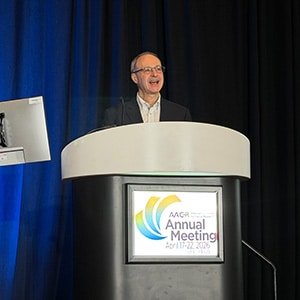

Welcome to the first day of Cancer Research Catalyst’s live coverage of the AACR Annual Meeting 2026. Each day, we will report on the exciting new advances presented, including clinical trial results, recaps from various scientific sessions, and other highlights from the meeting. Updates will be posted throughout the day, so be sure to keep checking back to stay on top of what’s happening.
Today, you can expect updates from the Educational Program that kicks off later this afternoon as well as a few more highlights as the meeting just gets under way.
Today’s Coverage
(All times are Pacific Time.)
10:15 p.m. – Educational Session Focused on Therapy Resistance and Strategies for Overcoming It
During the Educational Session entitled “Mechanisms of Resistance to Targeted and IO Therapies and Strategies for Overcoming Resistance,” presenters walked the audience through some of the main milestones in precision medicine. They discussed the problem of how, shortly after learning how to drug a new target, researchers inevitably need to start chasing the mechanisms of resistance to come up with new strategies—which often rely on combinatorial approaches.
The session was chaired by Kevan M. Shokat, PhD, FAACR, of University of California, San Francisco, a pioneer in KRAS-targeting research. Read more about Shokat’s journey to drugging the “undruggable” protein in this post.
Shokat reviewed the main phases of cancer evolution and highlighted that we now have many targeted therapies that interfere with oncogene activation, some that target loss of tumor suppressor function, and immunotherapies that tackle tumor immune evasion. He discussed how some of these different approaches could be combined to attack the cancer from multiple fronts. In the case of KRAS inhibition, during tumor evolution and development of therapy resistance, other passenger mutations arise. Since these mutations alert the immune system, they create an opportunity to combine KRAS inhibition with immune checkpoint inhibition.
“If we can pick the right oncogene inhibitors and pair those with the right [immune oncology] therapies, then I think we can get to better treatment outcomes,” said Shokat.
The next presenter Chiara Ambrogio, PhD, of University of Turin in Italy, took a deeper dive into intrinsic mechanisms of resistance to KRAS inhibition.
Quoting RAS mutation expert Channing Der, PhD—“Dogma is a moving target”—Ambrogio emphasized how, thanks to hard-fought progress, we have overcome the dogma of the undruggability of KRAS. She pointed out that, building on the transformative discoveries of Shokat and other pioneers in the field, we now have a growing number of KRAS inhibitor molecules in different phases of clinical evaluation, and we need a rational approach to validate them.
She shared several examples of preclinical models of disease her team uses to systematically dissect mechanisms of resistance and test combinatorial strategies to target them. She added that, once KRAS degraders will be available in the clinic and will be thrown in the mix, they will create even more opportunities for combination therapies.
Concluding the session, J. Silvio Gutkind, PhD, of UC San Diego Moores Cancer Center, discussed adaptive activation of the Hippo-YAP/TEAD pathway as a mechanism of resistance to targeted therapies, including through immune escape, and how his team has dissected the pathway and its interactions to overcome acquired resistance. He focused on uveal melanoma, a disease with low mutational burden and limited tumor heterogeneity, which provides a good model to investigate mechanisms of resistance, he explained.
The fight against cancer is a team effort, he concluded, as he invited new collaborations that may help evaluate more of the players involved in resistance.
6:30 p.m. – The Dark Side of Cancer Therapies—And Potential Solutions
During “The Dark Side of Cancer Therapies: Therapy-induced Comorbidities Across the Lifespan,” researchers discussed some of the long-term effects of cancer treatments on survivors as well as developments into potential interventions.
Sheila A. Stewart, PhD, of Washington University in St. Louis, focused her presentation on chemotherapy-induced peripheral neuropathy (CIPN), which can cause pain, tingling, and numbness in the hands and feet. About 70% of patients receiving chemotherapy experience CIPN, and between 20% to 30% continue to experience symptoms over the course of their entire life.
Knowing that senescent cells can influence neighboring cells, Stewart and her colleagues wanted to examine if these cells could play a role in driving CIPN. They found that when they inhibited p16-positive senescent cells in mice prior to chemotherapy, they were able to prevent CIPN. Additionally, when they killed these senescent cells after the onset of CIPN, it improved symptoms. They also found that inhibiting MK2 activation in senescent fibroblasts had a similar impact in preventing and treating CIPN. One way to inhibit these cells in patients could be with a class of drugs known as senolytics.
“We think this is very promising as a potential [treatment for CIPN] to move forward in a clinical trial,” Stewart said.
Charles Limoli, PhD, of the University of California, Irvine, spoke about the impact of cranial radiation therapy, which is a primary treatment for many forms of brain cancer. In the case of pediatric patients with low-grade gliomas, about 80% of those treated with radiation therapy survive long term, but 60% to 75% develop cognitive deficits over the course of their lives. These deficits can include memory issues, reduced focus and processing speed, and an impact on motor functions and verbal ability.
To alleviate the adverse effects of radiation exposure, researchers have seen promising results by transplanting stem cells or extracellular vesicles derived from stem cells into the brains of rodents. Even a single systemic injection of extracellular vesicles was able to improve radiation-induced neuroinflammation and cognitive function without the need for surgery or immune suppression. Another promising strategy is FLASH radiotherapy in which ultra-high doses of radiation are delivered much faster than typical radiotherapy—in seconds compared to minutes. In animal models, this method has spared cognitive decline and reduced neuroinflammation.
Limoli said this new type of radiation delivery could “revolutionize the way we treat cancer patients,” emphasizing that it could be used beyond brain tumors once results have been confirmed in clinical trials.
Melissa Maria Hudson, MD, of St. Jude Children’s Research Hospital, explained how childhood cancer survivors typically face multiple long-term effects from treatment. One study found that by age 50, childhood cancer survivors have an average of 17.1 chronic health conditions with 4.7 of them being classified as severe/disabling, life-threatening, or fatal. On top of this, these survivors also face financial hardships that have been associated with an increased risk of anxiety, depression, and suicidal ideation.
To help children and young adult cancer survivors avoid these long-term issues, Hudson recommended supporting them beyond their oncology care with evaluation of their educational progress and psychosocial functioning and access to resources to address potential issues; promoting healthy behaviors such as a nutritious diet and physical activity; and offering education about the long-term impact of cancer treatments and screening options to monitor for subsequent cancers.
5:35 p.m. – A Naturally Occurring Transfer System With Therapeutic Potential
Friday afternoon at the AACR Annual Meeting 2026 marked the beginning of the Educational Program, which offers attendees opportunities to expand their knowledge base in all areas of cancer research with updates on critical topics and new technologies. More sessions will take place tomorrow.
Since the first isolation of extracellular vesicles in the 1940s, research into these structures has continued to reveal new insights and therapeutic opportunities, according to speakers at this afternoon’s Educational Session on “Next-generation Extracellular Vesicles and Particles as Biomarkers, Targets, and Deliverables.”
Crislyn D’Souza-Schorey, PhD, of the University of Notre Dame, explained that extracellular vesicles and particles (EVPs) help support and sustain tumor microenvironments by facilitating cell-cell communication (through the transfer of proteins, nucleic acids, or lipids), regulating cell signaling, and promoting angiogenesis, among other mechanisms. She also shared recent insights from her research group into how EVPs form and encapsulate different types of cargo, including DNA and RNA.

Next, Dolores Di Vizio, MD, PhD, of Cedars-Sinai Medical Center and Sapienza University of Rome, explored how studying large oncosomes, a type of EVP produced by aggressive cancer cells, can help identify biomarkers of disease progression. She shared data from her team showing that large oncosomes promoted metastasis in mice by driving the migration of immunosuppressive neutrophils to the bone marrow, which led to an immunosuppressive phenotype prior to metastasis formation. Di Vizio also noted the power of high-throughput multiomics analyses of cancer-derived EVPs to identify disease biomarkers, sharing that proteomics analysis of large oncosomes isolated from the plasma of patients with metastatic castrate-resistant prostate cancer identified proteins associated with progressive disease.
Finally, session chair David Lyden, MD, PhD, of Weill Cornell Medicine, discussed the potential of T cell-derived EVPs to enhance tumor immunogenicity. He shared data from his lab demonstrating that the EVPs formed by activated T cells are enriched for DNA copies of genes that regulate antigen processing and presentation. Delivering these EVPs to immunologically cold tumors turned them into immune-responsive ones and improved response to immune checkpoint inhibition in mice. Lyden described T cell-derived EVPs as “a naturally occurring gene transfer mechanism” that may “inspire the development of novel nonviral gene delivery systems for plasmid DNA.” (Learn more about Lyden’s research when he delivers the AACR-Princess Takamatsu Memorial Lectureship on Sunday, April 19, at 4:30 p.m.)
2:30 p.m. – Meet and Greet for Global Scholar-in-Training Awardees
Every year, AACR provides support for young researchers in countries building cancer research capacities to attend the Annual Meeting through the Global Scholar-in-Training Award (GSITA) program. This year, AACR also launched the Amgen Global Scholar-in-Training Award, which is focused on supporting early-career cancer researchers across Africa. In total, 20 GSITA recipients are attending this year’s meeting. (Learn more about the awardees in this blog post.)
This afternoon, the GSITA recipients gathered for a meet and greet, where they shared more about their research, explained how they work to overcome the challenges they face, and practiced giving their “elevator pitch” to help prepare them to make new connections throughout the course of the meeting. In addition to the meeting itself, these recipients will also have the chance to visit UC San Diego Moores Cancer Center on Wednesday where they will go on a tour of the facilities and participate in a roundtable discussion with some of the faculty members. On Tuesday, they will have the chance to meet with AACR leadership, including Chief Executive Officer Margaret Foti, PhD, MD (hc), and 2026-2027 AACR President Keith T. Flaherty, MD, FAACR.
“This was such a enlightening experience, meeting people from so many places and working on interesting topics. It really brings a lot of hope on the future of cancer research,” said GSITA recipient Laura Rey-Vargas, MSc, PhD, of Pontificia Javeriana University in Colombia.
Another GSITA recipient, Muhibullah Ghafoorzai, MBBS, of Precision Medicine Lab in Pakistan, added, “If you ever want to be surrounded by scientific minds, never miss the chance to attend a gathering of GSITA awardees from around the world sharing ideas, discoveries, and inspiration. There’s so much to learn and explore.”
And Amgen GSITA recipient Maria Nomusa Sikhakhane, MSc, of Sefako Makgatho Health Sciences University in South Africa, said, “Across diverse projects and disciplines by the GISTA awardees, one thing is clear: The fight against cancer is shared. As new challenges emerge, so does a growing global community committed to solving them.”

12:55 p.m. – Registration Is Open
The registration desk opened for attendees at noon to pick up their badge or register on-site. Stop by any time today before 6 p.m. or any of the next five days starting at 7 a.m. And don’t forget to grab your ribbons to show off your ties to AACR.

Get Ready for Six Exciting Days of Cancer Science
Before the meeting gets started, revisit our premeeting coverage, including a behind the scenes look at how the meeting comes together, interviews with participants in tomorrow’s AACR Runners for Research 5K Run/Walk 2026, and a guide for early-career researchers on how to navigate the meeting.
Plus, check out the articles on AACR Annual Meeting News looking at what you can expect from the Educational Program, Professional Development Sessions, Plenary Sessions, and more.
The countdown to the AACR Annual Meeting 2026 is on—stay tuned for live updates starting at noon PT!