

Does cardiac muscle decondition like skeletal muscle and show signs of fatigue ?
June 16, 2026 by dr s venkatesan
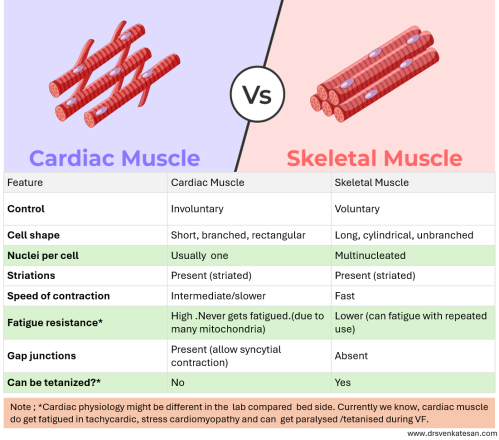
During physiology classes in medical schools, we are taught about the fundamental difference between cardiac and skeletal muscles. While skeletal muscle gets fatigued, cardiac muscle is unique in that it never takes rest, still it has the capacity not to get fatigued. We also learn calcium ions in a totally different way and that the cardiac muscle can’t be tetanized.
Is that all really true?
The tachycardic cardiomyopathy
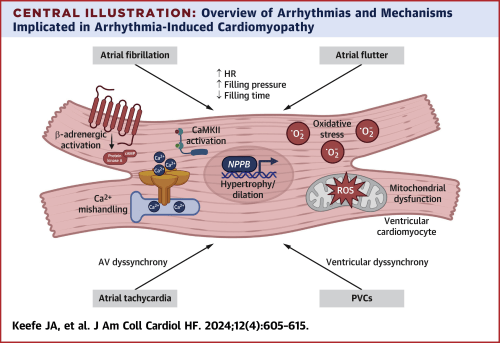
Here the cardiac muscle typically goes into short‑term or long‑term fatigue due to ATP depletion or exhaustion. Many recover; some hearts do not recover. So, what we learnt in physiology classes is not indeed entirely right. Physiological rules apply only within the physiological limits.
Cardiac muscle paralysis
Like skeletal muscle, cardiac muscle does paralyze when the heart rate becomes too rapid as in VT and finally ends in cardiac convulsions called ventricular fibrillation. We are not clear whether stress cardiomyopathy and resulting ballooning of the apex is an expression of cardiac muscle fatigue and weakness.
Final message
It looks like cardiac muscle do get fatigued like skeletal muscle, but only beyond physiological limits. The reality and the clinical implication is more tricky as this physiological limit can vary very much between individuals. We need to assess and assist such hearts by metabolic means and to give adequate rest to recover. In cardiac failure, exercise prescription can either be useful or counterproductive in chronically fatigued hearts.
Postamble
If the heart fails to relax in diastole,(the short time it gets in between two contraction) it results in diastolic dysfunction. We have always looked diastolic dysfunction in a hemodynamic perspective. It is time , we need to look into the metabolic and biochemical and molecular basis of LV relaxation.
Reference
1.Kayanakis JG. Le syndrome de “déconditionnement musculaire” de l’insuffisance cardiaque chronique [The syndrome of “muscle deconditioning” in chronic cardiac insufficiency]. Arch Mal Coeur Vaiss. 1989 Jul-Aug;82(8):1455-8. French. PMID: 2508599.
2.Shoureshi P, Tan AY, Koneru J, Ellenbogen KA, Kaszala K, Huizar JF. Arrhythmia-Induced Cardiomyopathy: JACC State-of-the-Art Review. J Am Coll Cardiol. 2024 Jun 4;83(22):2214-2232. doi: 10.1016/j.jacc.2024.03.416. PMID: 38811098.