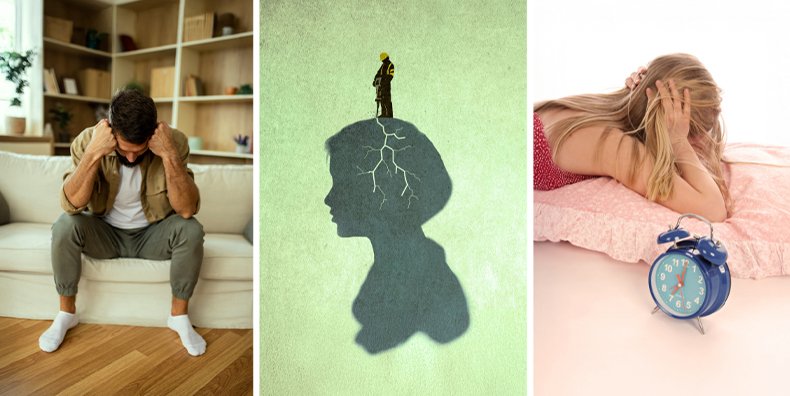

New research on lingering symptoms between episodes, early trauma’s mark on the brain, and what your child’s sleep really means.
Key Takeaways
- Even when your mood is stable, symptoms like slowed thinking, guilt, or physical tension can still affect daily life and may be treatable.
- Early adversity may influence brain development in people with bipolar disorder, which is why sharing your history can help inform care.
- Sleep problems in children can be important signs of overall mental health, but they are not a unique warning sign related to a parent’s bipolar diagnosis.
____________
Not everything important about bipolar disorder shows up during a mood episode. Some of it lives in the symptoms that still make your day harder even when an episode has passed, in childhood adversity that may have shaped your brain, and in whether your child’s disrupted sleep means something. Research teams in three countries recently studied each of these issues. Here’s what they found.
Between Episodes, Some Bipolar Symptoms Harder to Live With Than Others
Your psychiatrist is pleased: Your mood episode has ended. Clinically, you’ve entered a period of stability. Still, as you go about your day, you might notice that something feels off. Researchers are now looking at which bipolar disorder symptoms stick around between episodes and which ones tend to make daily life most difficult.
A Spanish research team studied 413 people with bipolar 1 or 2 disorder who were not currently experiencing a depressive episode, to see what was still holding them back. Their findings, published in the Journal of Affective Disorders, showed that more than 45 percent still had lingering symptoms — most commonly, anxious thoughts, fatigue, and low motivation.
But the symptoms that showed up most often weren’t always the ones that made daily life hardest. When researchers looked at which symptoms were most tied to trouble functioning, a different set stood out: slowed thinking and movement, guilt, apathy, and physical anxiety symptoms like muscle tension or a racing heart. These symptoms still showed up fairly often, in roughly 19 to 25 percent of participants. Since they’re less common than symptoms like worry and fatigue, the researchers noted they might be missed during regular appointments.
What This Means for You
- Not all lingering symptoms affect daily life equally. Many symptoms can persist between mood episodes, but this study found that certain ones — like slowed thinking, guilt, apathy, and physical anxiety — are more likely to get in the way of work, relationships, and everyday activities. At your next appointment, talk about these or any other symptoms you think are making your life harder, even if your provider doesn’t ask about them directly.
- These symptoms are treatable. Even symptoms that aren’t linked with a mood episode can still benefit from treatment. Although this study didn’t focus directly on treatments, the researchers say a combination of medication and psychotherapy is likely to help.
*****
Childhood Trauma Leaves a Distinct Mark on the Bipolar Brain, Study Finds
Childhood trauma is common among people with bipolar disorder, and evidence is mounting that early adverse experiences leave a biological trace, not just a psychological one. A new brain imaging study adds to that evidence, finding that the trace looks different in bipolar disorder than in major depressive disorder.
Researchers in Italy scanned the brains of 260 adults hospitalized for a depressive episode — 120 with bipolar disorder and 140 with major depressive disorder. All completed a questionnaire about childhood experiences, including physical abuse, emotional abuse, and neglect. A subset of 72 people with bipolar disorder and 90 people with major depressive disorder also provided DNA to measure how many genetic variants linked to bipolar disorder they carried.
The scans measured white matter, the brain’s communication network of insulated nerve fibers that connect different regions. For people with bipolar disorder, higher scores for childhood trauma were consistently linked to worse brain wiring across large parts of the brain. This pattern was mostly not seen in people with major depression. The findings, published in European Neuropsychopharmacology, held even after accounting for age, illness length, medication, and other factors.
What This Means for You
- Your trauma history is clinically relevant. This research suggests that childhood adversity might be linked to changes in white matter in people with bipolar disorder. Other studies have found that the health of these nerve fibers can affect how bipolar develops and progresses. For example, one study found associations between white matter and cognition, while a large analysis of studies linked white matter to age at first episode. The researchers behind this current study suggest that early trauma could influence aspects of bipolar disorder through its effects on brain wiring. They note that this is a hypothesis, not a proven connection. But if you haven’t discussed your trauma history with your care team, consider bringing it up so your providers can factor your early experiences into your treatment plan.
- This is a snapshot, not a verdict. The study only included hospitalized patients at a single site in Italy, so the findings may not apply to everyone with bipolar disorder. It also doesn’t cover whether these brain differences develop before illness onset or worsen over time — questions the researchers say future long-term studies are needed to answer.
- The boundary between depression and bipolar disorder may be fuzzier than it looks. Among patients diagnosed with depression who carried more bipolar-linked genetic variants, brain patterns resembled those of the bipolar group. This adds to the growing evidence that for some people, the two conditions share more in common biologically than a diagnosis alone captures — though this piece of the study was smaller and needs replication before drawing firm conclusions.
*****
What Your Tween’s Sleep Problems Mean When You Have Bipolar Disorder
When you have bipolar disorder, you become acutely aware of your own sleep patterns because you know what changes can mean for your mood.
So when your child has a run of bad nights or can’t seem to settle, it’s hard not to wonder: Does it mean something different than it would for another child because of your diagnosis?
A new study published in Schizophrenia Research suggests the answer is no. While earlier research found that children of parents with bipolar disorder do face a higher risk for mental health conditions themselves, this study suggests that sleep problems aren’t a special signal for this group. The findings indicate that poor sleep is linked to mental health conditions in kids generally, not just in those with a parent with bipolar disorder.
This research is part of the Danish High Risk and Resilience Study, which follows children born to parents with bipolar disorder or schizophrenia. For this study, researchers examined 447 children aged 11 and 12 in three groups: those with a parent diagnosed with bipolar, those with a parent diagnosed with schizophrenia, and a control group with no family history of either. They tracked three specific sleep problems — nightmares, difficulty falling asleep within 30 minutes, and waking during the night. Then, they looked at how these sleep issues related to early psychotic experiences and mental health diagnoses in the children. They found:
- Tweens with a mental health diagnosis were roughly twice as likely to experience each of the three sleep problems, though the pattern varied by condition.
- Children with externalizing conditions like attention-deficit and hyperactivity disorder (ADHD) were particularly likely to have trouble falling asleep and waking during the night.
- Kids with anxiety or mood disorders also woke more often at night, but were not more likely to struggle to fall asleep. They were, however, more prone to nightmares.
Importantly, the connection between mental health and sleep appeared in all three groups: children of parents with bipolar disorder, children of parents with schizophrenia, and the control group. Family history did not affect the relationship between sleep and mental health.
What This Means for You
- Sleep problems in children are worth raising with a doctor, regardless of your family history. In this study, children with anxiety, mood disorders, ADHD, and other diagnoses were significantly more likely to have disrupted sleep. Parents with bipolar disorder don’t necessarily need to be more vigilant about their child’s sleep than any other parent. But all parents should talk to their child’s doctor if their child regularly has trouble falling asleep, wakes during the night, or has frequent nightmares.
- Improving sleep might also support your child’s mental health. The researchers note that other studies have found that sleep interventions show real promise in reducing psychiatric symptoms in children, suggesting that if your child is sleeping poorly, improving their sleep quality might help with more than just how rested they feel.
Editorial Sources and Fact-Checking
- De la Serna E et al. Effects of Parental Characteristics on the Risk of Psychopathology in Offspring: A 4-Year Follow-Up Study. European Child & Adolescent Psychiatry. April 16, 2025.
- Bonnín C et al. Psychosocial Functional Recovery in Patients With Bipolar Disorder in Remission: Which Symptoms Hold Them Back? Journal of Affective Disorders. June 15, 2026.
- Paolini M et al. Different Effect of Adverse Childhood Experiences on White Matter Microstructure in Major Depression and Bipolar Disorder: Moderating Role of Genetic Liability. European Neuropsychopharmacology. February 2026.
- Masuda Y et al. White Matter Abnormalities and Cognitive Function in Euthymic Patients With Bipolar Disorder and Major Depressive Disorder. Brain and Behavior. October 3, 2020.
- Favre P et al. Widespread White Matter Microstructural Abnormalities in Bipolar Disorder: Evidence From Mega- and Meta-Analyses Across 3033 Individuals. Neuropsychopharmacology. August 21, 2019.
- Søndergaard A et al. Associations Between Sleep Problems, Psychotic Experiences and Mental Disorders in Children at Familial High Risk of Schizophrenia or Bipolar Disorder and Population-Based Controls – The Danish High Risk and Resilience Study. Schizophrenia Research. May 2026.